Thursday, June 5, 2014

Don't Ask, Don't Tell (part 2)

This post comes a week late. I intend to pick up on the theme of shame that I brought up in the first instalment of "Don't Ask, Don't Tell," but I've really been struggling with it, and I'm not sure why. So rather than continue to over-analyze and self-edit, I'm just going to jump in and see where things go.


Cage of Shame, Levoča, Slovakia
(image licensed under Creative Commons)
In Part 1 I wrote about shame and how it impacts people with chronic illness, specifically inflammatory bowel disease (IBD). My sister commented on the post and left a link to an incredible TED talk by Brené Brown, Research Professor of Social Work at the University of Houston. In it Brené talks about the relationship between vulnerability, shame, and how shedding a light on shame--speaking about that which shames us--perhaps doesn't eliminate, but certainly reduces, the power that shame holds over us. This has certainly been true in my case; speaking and writing about my experience living with Crohn's, and now an ileostomy, has been incredibly empowering. Yet I still find myself procrastinating over this post, and I can't quite figure out where that hesitation is coming from. 

In her talk on shame, Brené describes the "vulnerability hangover" that she experienced after giving her first TED talk the year before. I want to be honest in what I write in this space, because this blog is as much about working through things for myself as it is abut educating and supporting others. But I'm afraid of sharing too much, of inviting too many people in too intimately. I do, in short, fear the vulnerability hangover. But, as Brené points out, opening up and inviting people in is exactly what is necessary to move past shame. She says:
Shame is an epidemic in our culture. And to get out from underneath it, to find our way back to each other, we have to understand how it affects us and how it affects the way we're parenting, the way we're working, the way we're looking at each other. [...] If we're going to find our way back to each other, we have to understand and know empathy because empathy's the antidote to shame. If you put shame in a Petri dish, it needs three things to grow exponentially: secrecy, silence, and judgement.
(image licensed under Creative Commons)
For a long time I lived in secrecy and silence about my Crohn's because I feared the judgement. I didn't want my Crohn's to affect my relationships, particularly those that were still developing. I didn't want my Crohn's to define me. I still remember meeting a friend of my aunt's for the first time, and after my aunt introduced us her friend's first words were, "Oh, you're the one with Crohn's!" That's exactly what I didn't want; I didn't want people to remember my disease before they remembered my name. I still don't want that, but over the years, as I slowly got sicker and sicker, I learned to embrace that part of my identity because Crohn's does define me--at least a part of me, anyway. I would not be who I am today if I did not have Crohn's, and now an ostomy. How could I expect anyone to accept me without judgement if I couldn't even accept myself? In many ways, the world sees us as we see ourselves; we wear the lens through which others view us. If we project nothing but self-criticism and chronic shame, how can we expect the world to give us anything back other than judgement?

In her talk on shame, Brené reminds us that Carl Jung referred to shame as "the swampland of the soul." It is such an apt metaphor. It is so easy to get mired in shame to the point that we cannot extricate ourselves unaided. And that's where empathy comes in for, as Brené says, "The two most powerful words when we're in struggle: me too." But in order to allow others to empathize with us, we first need to open up, to--in short--be vulnerable. It took me a lot of years to learn that lesson. I needlessly suffered alone for so very long, and it came at the expense of my mental health. Ironically, even though mental illness is probably among the most stigmatized of health issues, I was more willing to discuss my depression than I was my Crohn's. But when I finally did start opening up about my Crohn's, do you know what happened? People almost always responded with empathy and support rather than suspicion and judgement. That's why, from day one, I decided to talk about my ostomy. I'm done hiding.

One last thing before I end this post: I should address the title. The reference to the American military's "Don't Ask, Don't Tell" (DADT) policy is intentional. DADT created a legacy of shame that is only today being addressed, if not redressed. DADT has also become shorthand for how shame is endemic and even institutionalized in our culture. I've learned, since letting go of my own shame, that it can be internalized to such an extent that we no longer realize the impact it's having on our lives. And that's the real shame in all of this.

(image licensed under Creative Commons)

Monday, May 26, 2014

Beautiful Boy (Darling Boy)

I can't believe that tomorrow my beautiful boy turns three! Has it really been three years since I first held my 3 lb 12 oz miracle in my arms? I have always intended to record Euan's birth story, but life always seems to get in the way of me actually sitting down to do it.  Although Euan's entrance into the world is not something I'm likely ever to forget, I do fear that as the years go by the finer nuances of the moment will be lost. So, Euan, today's post is dedicated to you with unconditional, incomparable, immeasurable love.

Euan, counting gummy worms to go on his "dirt" birthday cake.
Much like the rest of my health-related experiences, my pregnancy was...complicated. My Crohn's was, happily, very well controlled at the time, so that at least was not an issue. By the time I reached 21 weeks, however, I was on sick leave from work with gestational diabetes and barely controlled hypertension. Euan was due July 9, 2011, and I had a c-section scheduled for July 2. [As an aside, since my last post brought up the notion of shame, in some future post I'll deal with the shame--care of the "Mommy Industrial Complex"--that came with my physical inability to have either a vaginal birth or breast feed my child.] After consulting with my maternity doctor, my obstetrician, my GI specialist and, lastly, my GI surgeon, I had finally accepted the fact that my IBD would not allow for the natural, vaginal birth that I had always dreamed of. I was, of course, profoundly disappointed, but kept reminding myself that the end goal was both a healthy baby and a healthy me. Given the unpredictability of my Crohn's and the cocktail of meds that I had to give up before Blaine and I could even start trying to conceive, the fact that I had gotten pregnant after only 9 months of trying seemed, in itself, nothing short of miraculous.

On Sunday, May 1 Blaine and I caroused with friends at a May Day BBQ. There was cause for celebration because, serendipitously, four other couples within our social circle in Kelowna were also expecting that year, though our baby was due first. I'll always remember that as the last carefree day prior to Euan's arrival. On May 2, at a routine prenatal checkup, my maternity doc was concerned by elevated levels of protein in my urine, accompanied by another rise in my blood pressure, both of which are warning signs of preeclampsia. She sent me to the hospital to have a nonstress test (NST) administered. During the test, the baby (who we didn't know then was Euan, as we'd chosen no to find out the sex) didn't perform satisfactorily, and my blood pressure remained elevated. I was admited to the hospital for monitoring. I remember breaking down the moment Blaine arrived at the hospital, terrified that we were going to have a baby that night. Luckily that didn't happen; I was sent home 3 days later, hypertension precarious but controlled by increased doses of meds.

Hooked up to the NST monitor on the morning of Euan's birth day.
By May 19, my blood pressure was haywire again and I was readmitted to hospital. This time, I knew that I wouldn't be going home before my baby was born, and it became my job to keep the kid inside me for as long as I could, which turned out to be just over a week. By this point I was having weekly ultrasounds to measure the baby's growth, and the May 25th scan showed that Echo (that was his name before he became Euan) hadn't grown at all since the week before. This was the sign my OB was waiting for, and he informed Blaine and I that we'd be having a baby on the 27th. Terrified, excited, exhilarated, and overwrought, we had nothing to do but wait.

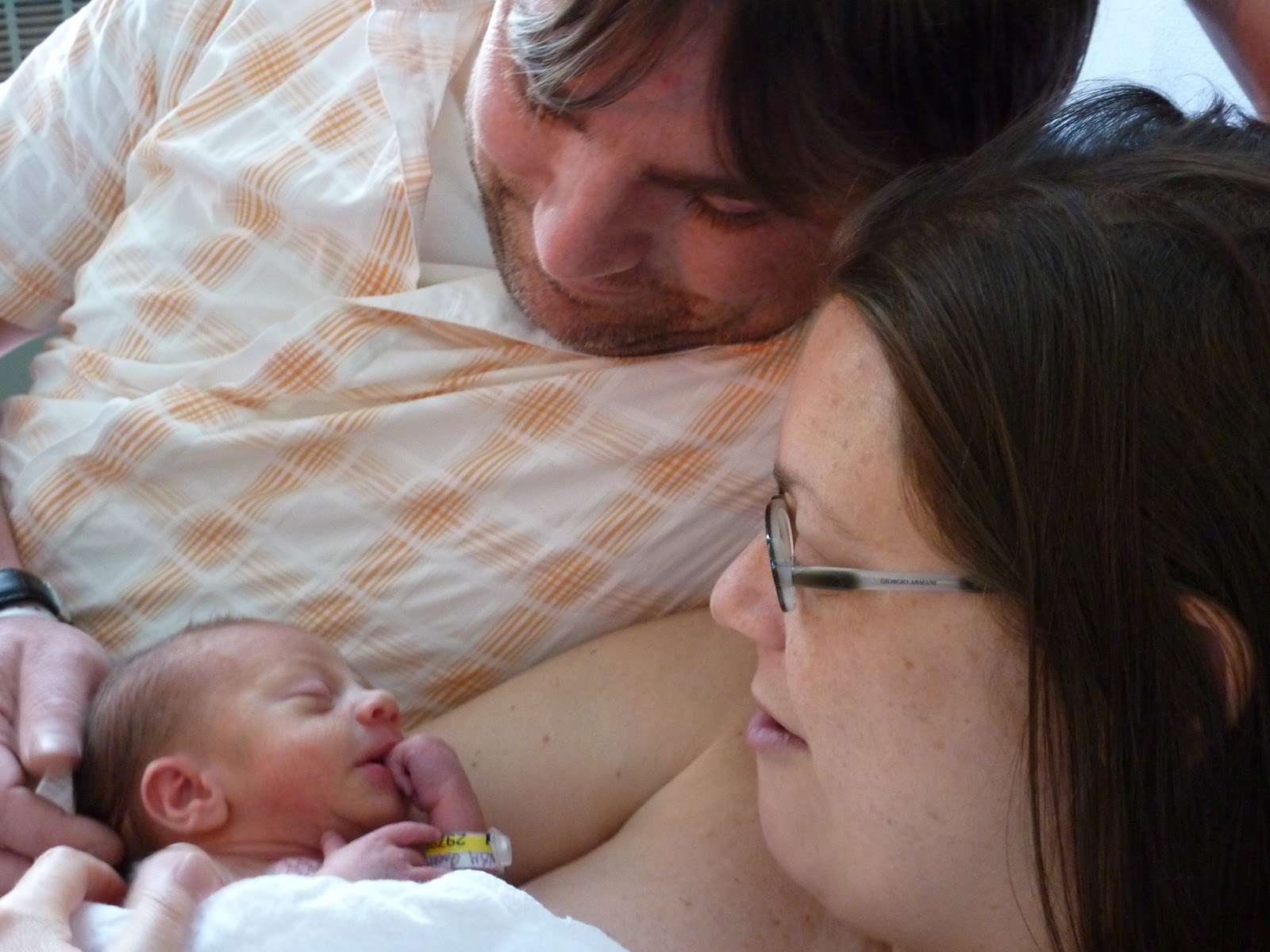
Euan with Daddy in the NICU, minutes after birth
Our precious bundle arrived, healthy, whole, and tiny, at 4:03 PM on May 27th, 2011. I will never forget the intensity with which I focused on the sounds and sensations taking place on the other side of the blue surgical sheet that separated my head and my belly. When Blaine was finally allowed into the OR and he took his place at my head and grasped my hand, I was so tuned into the birth experience that I didn't even know it was him until he finally spoke--I thought it was a nurse holding my hand and offering support. I knew the moment was close as the pushing, tugging, and suctioning intensified on the other side of the sheet, and with one final squelch, our baby was born. I'm sure I gripped Blaine's hand close to breaking as the doctor announced, "It's a boy!" Blaine and I looked at each other, tears rolling down our cheeks, and I let go of the breath I wasn't even aware I was holding as I heard Echo--now Euan Peter--wail for the very first time. For a moment it felt as though the world stood still while Blaine and I took it in: it's a boy, we have a son, we are parents; but very quickly the delivery team sprang into action. There was the obstetrician, maternity doctor, anesthetist, and three nurses taking care of me, plus a pediatrician and two additional nurses taking care of Euan. He arrived so strong and healthy that he surpassed everyone's expectations, and the whole delivery team exclaimed at how perfectly proportioned he was. Within moments Euan was so pink and alert that he was swaddled and placed in Blaine's arms near my head so that I could see and touch him with my one free hand. He kept wanting to cry, but each time I spoke, cradling him with my voice since I could not hold him in my arms, he settled. He knew me already. And I knew him. "He looks so familiar," I said to Blaine, my eyes searching Euan's small face, trying to take in every minute detail, "just like his ultrasound images. I knew he had your nose."

Our first moments as a family were short lived, however, and soon Euan was whisked off to the neonatal intensive care unit, where all premature babies spend the first days and weeks of their lives. Blaine went with him, never leaving his side while I was sewn up and sent to recovery. I remember staring at the wall clock across from my recovery bed, watching the minutes pass by as I giddily waited for the moment when I could hold my son again. My obstetrician and maternity doctor both made separate visits to my bedside to assure me that Euan was perfect and doing well, and that Blaine was still with him. For me, though, things were about to get complicated--again.

Our first visit on the evening of Euan's birth.
The cure for gestational hypertension is to deliver the baby. My blood pressure should have begun to stabilize relatively quickly after Euan's birth. Of course, nothing about me is textbook--apparently I enjoy being a special case--and my blood pressure spiked dramatically while I lay in recovery. Normal blood pressure should be somewhere close to 120/80; mine rose to a dangerous 200/130. It's probably good that I didn't realize at the time just how much danger I was in. As the recovery room nurses raced to prepare me a bolus of anti-hypertensives to administer quickly by IV so that I wouldn't have a stroke and to hang a bag of magnesium sulfate to prevent seizures, I glibly quipped, upon seeing my numbers, "Well that's not good!"--an astounding understatement. Once I finally left recovery I was sent back up to Labour & Delivery rather than being transferred to the maternity ward because I needed to be monitored closely for the next 24 hours. The magnesium sulfate incapacitated me to such a degree that I don't remember much of that time except that, when a NICU nurse finally brought Euan to see me, I was afraid to hold him because I felt so stoned. When the OB on call came to see me the following afternoon and ascertained that my slurred speech, physical incapacitation, and mental confusion were side effects of the magnesium sulfate and not a stroke, I was finally transferred to the ward where I would be free to come and go from my room to visit Euan in the NICU as often as I wished.
Out of the incubator for a feeding.
Having a premature baby is hard. It was an emotionally exhausting experience, and we know we were incredibly lucky. Euan lived in the NICU at Kelowna General Hospital for the first three weeks of his life, but he was wonderfully healthy and suffered no complications from his small size and early arrival. I know that many families of preemies face much more difficult situations than ours. I was released from hospital when Euan was five days old, and leaving without my baby was probably the hardest thing I've had to do. I wept--a lot--that day. But we quickly got into a routine of going to the hospital several times a day for Euan's feedings and fitting in around it the rest of life and its attendant responsibilities. There is no choice but to adapt to circumstances that we cannot control. 

My first child may not have arrived at the time or in the manner that I had expected, but he had arrived and I was just grateful that I was able to hold him in my arms--tubes, wires, and all--because not all mothers with babies in NICUs are so lucky. I know that people often say that each baby is a miracle, but to me Euan really was my miracle child: it was miraculous that I managed to conceive while living with the ups and downs of a chronic illness; it was miraculous that I escaped my postpartum complications unscathed; it was miraculous that Euan thrived beyond all medical expectations for a baby in his situation. And I am doubly blessed, because though Euan was my first, I am now able to cradle a second miracle both in my arms and in my heart. 


Thursday, May 22, 2014

Don't Ask, Don't Tell (part 1)


(image licensed under Creative Commons)
In my previous post I made brief mention of the sense of isolation one feels when dealing with a chronic illness. In writing this post I quickly discovered that I have *a lot* to say on the subject, so I've divided it into two instalments.

I would say that experiences of alienation or isolation are especially true of inflammatory bowel disease (IBD) patients, but Freya Symes, in her wonderful blog Finding Freedom with Epilepsy, recently gave voice to many of the concerns I face. Though I do find comfort in knowing that many people are struggling with the same issues I am, I do believe that each case is unique and not all illnesses are created equal. I was, for example, quite shocked to learn from Freya of the many ways in which epileptics are alienated and ostracized. I've never believed that epilepsy is a contagious condition, so I was surprised to read in Freya's blog how many times she's felt shunned for that very reason. I, of course, can only speak to the Crohn's case generally and my own experiences specifically. 

When I was first diagnosed with Crohn's disease in March 1997, my initial instinct was then, as it is now that I am living with an ostomy, to get involved. So I joined my local chapter (I still lived in Calgary at the time) of the Crohn's and Colitis Foundation of Canada (CCFC) and soon held a position on the executive council. Two things stand out for me, all these years later, from my time volunteering for the CCFC. First, it was through my work with the Calgary chapter that I met Dr. Remo Panaccione, who became my GI specialist. Meeting Remo was life-changing at that time because he helped me not only to understand my condition more fully, but also gave me the confidence to start taking control of my own healthcare experiences (a process which is ongoing). I trusted Remo to such an extent that, when I moved to Edmonton in 2001 for grad school, I continued to return to Calgary for treatment under Remo's supervision. I made the 3-hour (one way) commute regularly until 2003 when I was hospitalized for the first time because of complications related to my Crohn's and required more frequent and closely monitored medical care.

The second thing that has stuck with me for all these years is an off-hand (and rather flippant) remark made at a chapter meeting during a discussion of potential fundraising options. Someone on the executive suggested we hold a gala benefit and silent auction. The idea was immediately poo-pooed (no pun intended) as unrealistic. "IBD isn't 'sexy' like cancer. We'd never raise enough money to cover our costs." Now, this comment wasn't meant to offend cancer survivors, but to point out the hierarchy of awareness among the general public whose hard-earned cash is coveted by hundreds of charities supporting a multitude of medical conditions. Cancer is "sexy" because it has the best name recognition thanks to the massive charity machine driving the cause. Think of Terry Fox and the many "Walks for the Cure" you've seen advertised on TV. In North America it's culturally acceptable to talk about cancer. As Freya points out with respect to epilepsy, some conditions remain well outside of our cultural consciusness, and in many cases stigmas still hold fast. This is certainly true of IBD.

I refer to Crohn's as my "poo problem." And "there's the rub," as Hamlet would say. You don't talk about poo in polite company. No one wants to know how many times I've run to the toilet on a given day, nor how many times I've had to change my pad because my fistulas won't stop oozing. Nope, you just don't talk about it. When I'd call in sick to work because I couldn't leave the bathroom for more than 5 or 10 minutes at a time, I'd say I had a migraine. Once I became friendly with the receptionist in the Faculty of Arts office and had confided in her about my illness, she understood that "migraine" was really code for "I'm spending the day in my underwear because if I have to waste time unzipping my pants I'll shit myself." She insisted the code wasn't necessary, that other people just called in and said they had diarrhea. I couldn't help but wonder what horrible ailments those professors were dealing with if diarrhea was the excuse they willingly left on the office voicemail! But it all comes down to the same thing: shame. Where do each of us draw the invisible line between what is simply embarrassing and what shames us?

We're taught early to hide our bodily functions, even from our closest family. By two and a half years old, my son--unprompted by anyone, as far as I know--started "hiding" to poop. This usually meant squatting behind the coffee table or in the corner beside the TV. Now that he's nearly three and potty training is underway, he makes me sit on the edge of the tub and cover my eyes while he goes. "Mummy don't look at me," he'll exclaim if I sneak a peek. Where does this come from, this seemingly innate instinct to keep the workings of our bowels private? Is it the beginnings of shame that is exhibited in Euan's behaviour? It's certainly not modesty: he happily stands in the tub to watch himself pee at the beginning of every bath time, inviting me to witness the event with an excited, "Look, mummy! I'm peeing!" What difference has he perceived in adult behaviours surrounding peeing and pooping? What makes one acceptable, even funny, and the other disgraceful? And what happens to those of us whose lives become overrun by and identities entangled with that which we are supposed to be ashamed of? See why I need two posts to deal with this? It's a lot to digest! (Again, no pun intended--well, maybe a little one.)

Monday, May 19, 2014

Here Comes the Sun


(image licensed under Creative Commons)
The May long weekend has arrived and that means, inevitably, it's raining. Except for the one or two dull, cloudy days that have punctuated each week for the last month, however, sunshine has returned to Kelowna with the arrival of Spring after the seemingly endless monochromatic cloud-cover and valley fog of an Okanagan Winter. Magnolias bloom voluptuously; redwing blackbirds sing riotously. Leaves burst from branches, tender and bright; marmots laze on rocks, languorous and sleepy. Yes, the sun has indeed returned and, swaddled in its warm embrace, I find myself in a sudden and unexpected state of almost indecent happiness. Nature is renewing itself, and I can't help but feel that I am, too. So, it is in this spirit of rebirth that I am relaunching Sunshine and Simple Things.

It is fitting that my last post, written just over a year ago, was about the difficulty I was having balancing work and family life while also coping with the worst flare up of my Crohn's disease I'd ever experienced. At the time I wrote that post, I'd been debilitated by the Crohn's to such an extent that just a week later I decided my only hope of getting healthy and finding some sort of equilibrium was to go on sick leave from work. Thus started a cycle: off work, then back, then off again. In 2013 I managed to work full-time for all of five months, but I was in the classroom teaching for zero of them. It had finally happened: Crohn's had taken control of my life, effectively usurping Blaine and Euan from their place at the centre of my world. If the flare up eased for a day or two, we were all happy; if things were bad for me, everyone suffered. No one was happy.

Miraculously, despite my ill health I managed to get pregnant in early Spring 2013. Fittingly, I discovered the happy news on Mother's Day. Of course, this made treating the disease that much more challenging for my gastroenterologist, and the pregnancy was...tumultuous. Trying for a baby may not have been the smartest choice given the circumstances but, considering how rapidly my condition was deteriorating, I truly believed that if I didn't manage to conceive a second child now, I never would. The Crohn's didn't get much worse while I was pregnant (thankfully), but it also didn't get any better (unfortunately). I was plagued by anxiety over how my constant state of malnutrition would affect the baby, even though my obstetrician assured me that my little parasite would take everything it needed first, and my body would survive on leftovers. This proved to be true: on December 27, 2013 beautiful Isla Huguette joined our family only two weeks before her due date. She was small (at only 5 lbs 11 oz, she was only 2 lbs bigger than Euan was, and he was 5 weeks early) but perfect and, to my great relief, wonderfully healthy. I, on the other hand, had lost over 20 lbs during the pregnancy, and at 4 days postpartum the sh** hit the fan, as they say.

I thought I'd been sick for the previous 14 months, but I'd never experienced anything like this. I was completely non-functional. I was lucky to be well enough to leave the house once a week; the rest of the time I spent writhing in pain, sometimes in bed, usually on the toilet. Thankfully, Blaine was on parental leave and we had plenty of family support because I could barely take care of my own basic needs, let alone those of an active 2 1/2 year-old and a newborn. Even though Isla was a fairly good sleeper most nights, only waking every 3 or so hours to feed, I was routinely running to the bathroom every 30-45 minutes, so I never felt rested and exhaustion only made my symptoms worse. And so I made the decision that I'd always known was inevitable: I would have ostomy surgery. I'll get into the details more in a future post, but for the uninitiated, having an ostomy (in my case, an ileostomy) means that a portion of my bowel is diverted through the abdominal wall and I poop into a bag. Pleasant, right? It's a sign of how sick I was that this was my most desirable option. I got the call from surgical booking on my birthday, and it was the best present I could have hoped for.

On March 7th I had the surgery, and now, nearly 2 1/2 months later, I feel as though I have indeed been given the best gift of all: I've got my life back. This is my Spring of renewal, rebirth, resilience. Laugh at the cliches, I don't mind. I've emerged from the dark and dreary world of pain, depression, and isolation that so often accompanies chronic illness, and I survived. Perhaps not unscathed, but alive and ready once more to enjoy the sunshine and simple things.

Tuesday, December 4, 2012

Working Girl

I know that, according to the experts, the key to a successful blog is regular posting. But...life can get in the way.

Tonight I'm having a cocktail and toasting the end of teaching for 2012. I still have a stack of grading waiting for me, but classes are over! And I survived.

I didn't just survive my first term back in the classroom after maternity leave, I survived my first term back in the classroom after maternity leave while also dealing with the most severe flare up of my Crohn's disease since 2006. Yup--I deserve a drink.

I've been lucky enough to have been pretty healthy for the last 3 years. Healthy enough to go off the meds that could harm a fetus, spend 9 months trying to get pregnant, 9 months pregnant (well, 7 and a half months), and 15 months at home with my babe. Then I went back to work and it all went to shit--literally. It's hard not to look for a correlation there...

I quickly identified my priorities this Fall, and I was a little surprised at the extent to which work wasn't anywhere near the top of the list. I was actually looking forward to going back to work in September. I was ready to get back in the classroom, and was excited to start my first term as Chair of my department. By the end of August the signs were there that my health was going to be an issue, and by the end of September I was already treading water at work and in life, but--true to my M.O.--I was in full denial. By the end of October I was barely functioning and denial was no longer an option. Instead I got a little perspective.

So as I prepare to spend the next 2 weeks finally catching up on all the marking that's been pushed to the back burner, I'm not sorry that I spent what energy I had in the last 3 months on my family. I'm not sorry that I spent my weekends enjoying late breakfasts and getting nothing accomplished. I'm not sorry that I spent my healthy moments laughing with my husband and son rather than chained to my laptop and all the student papers I should have been grading.

The moral of my story? I may not be capable of balancing life and work, and I'm okay with that. I will work to support my life, but at the end of the day, life is where real happiness lies.

Monday, November 19, 2012

The Sweetest Thing

Tonight I watched the latest episode of Emily Owens, MD on Video on Demand, and one of the cases featured was about a baby who needed heart surgery in utero if he was going to have any chance at survival. I watched the mother cry and clutch her round belly, and it made me think about the relationship I had with Euan before he was born.

Back then he wasn't yet a he, and to Blaine and I he was Echo or Baby E (because though we didn't know what we were having, our top boy and girl names both started with "E"). Even after I started feeling movement, the baby in my belly remained an amazingly abstract concept for me. In fact, for several weeks after Euan was born, I still referred to Euan and "the baby" as if they were separate entities. I had trouble reconciling the fact that they were one and the same. Now, looking back, I can see that part of the emotional upheaval I experienced in the first few days after Euan's birth wasn't just the result of gushing hormones; I was mourning the end of my pregnancy. Even though I was celebrating the (earlier than planned) birth of my son, I longed for the intimacy of carrying him inside of me. In the immediate aftermath of his birth, I didn't feel the same connection.

I feel terrible admitting that here, and for weeks--if not months--after Euan was born, I thought I must be a horrible mother because of it. I think Euan was at least a month old before I said to him "I love you" out loud. I thought it every time I kissed him and laid him down to sleep, but for what felt like the longest time I couldn't bring myself to say it out loud, and I didn't know why. I've thought about it a lot in the months since, however, and I think I've figured it out. The thing was, Euan was a stranger. I recognized him from his pictures (I'd had many ultrasounds in the weeks before he arrived), but I didn't know him. We didn't know each other.

The reason I can admit all this here, though, is because things have changed. Euan still isn't "the baby," but now he's my baby, and there are no words to describe that love. Now I say, "I love you, baby" a hundred times a day, without thinking about it, simply because I can't not say it. Euan and I have known each other for nearly 18 months now, and we've "become accustomed to each other's faces," as the refrain goes. The relationship isn't always perfect--he gets frustrated, I get impatient--but there is absolutely nothing like it. When I was pregnant I may have carried his body inside mine, but now I know I carry his heart. Corny? Maybe. Amazing? Awesome? Unparalleled? Definitely. What can I say? He's my son.


Sunday, November 11, 2012

Lest We Forget

Today is Remembrance Day, so of course my thoughts are with my grandfathers, who both fought in World War II, and who are both gone now. Each year in the week leading up to November 11th, as I watch the variety of TV specials dedicated to those who have fought and died in our many--too many--wars, I think about my grandfathers and all of the things I should have asked them. Should have, but never did.

It's an interesting thing, asking someone to talk about war. I think by the time I was old enough to understand what war meant, and that my grandfathers had both experienced it personally, I was also old enough to sense that many people don't want to talk about their war experiences. Even though my Grandpa Spidel made a career out of the military, and even though the walls of my grandparent's basement rec room were covered in the framed memorabilia of Grandpa's time in the Air Force, I can't remember him ever talking about the War. His time on the DEW Line during the Cold War, sure. Stories about meeting buddies in the Mess for coffee and camaraderie, okay. Exciting details about how, as a radar officer, he would track Santa's progress each Christmas Eve so all the kids on the base would know exactly when they had to be in bed and asleep, of course! But the War? Never. The closest he ever got--in front of me, anyway--was a reference once to a friend who had been a POW in a Japanese camp during the last months of the war. But I can't remember him ever speaking about his own war experiences. Not once.


Although I had a different relationship with my Grandpa Garrett, it was much the same. I knew he had been to the War, had served in the army and been on the European front. I even knew that he had come home with shrapnel embedded in his skull. (Years later we wondered if that had anything to do with the early onset of his Alzheimer's.) But Grandpa Garrett never spoke to me about his wartime experiences, and I never asked. And now, like Grandpa Spidel, he's gone, and so is my chance to find out what they went through.

War is still everywhere, but in Canada we are so very fortunate to not have it impact each and every one of us directly, and on a daily basis. The families of Canadian soldiers in Afghanistan and around the world live every day with the consequences of war, but most of us can go for days at a time--if we keep the news off--and not have war touch us. War is not real for most of us. It's something we encounter on TV, and in movies and video games. It's not in our pantries or our closets, and it's not at our dining room tables or in our beds at night. And for that privilege I stop today to think about my grandfathers, and all the other grandfathers and fathers and uncles and brothers, mothers, sisters, aunts, and friends, who have made it possible for me to sometimes forget just how lucky I am to live in a place where I am free. Free to remember, free to forget, free to protest, free to speak and to write. Free.


Friday, November 9, 2012

A Blog of One's Own

Why blog? This is the question I've been asking myself for ages. What terrain could I possibly cover that hundreds—or thousands—of bloggers haven’t trodden before me? I still don’t have the answer to that question, but recently the voice in my head has started asking, Why not blog? It started as a whisper, persistent and pestering, and has turned into a constant nag at the edge of my consciousness. Get over yourself, the voice says, stop assuming that what you write has to actually be read by anyone to have meaning and value. Do you think Virginia Woolf wrote letters and journals assuming that they would have a public audience one day? Well, maybe, but look at how she ended up. Who needs that kind of pressure? So, save for the small cadre of dedicated readers who have pledged to believe in me no matter what, I have decided to write for myself.

But the question remains—Why blog? Why not just get a nice, leather-bound notebook, or one of paper hand-made by a local artisan, and keep a journal? The thing is, when I do something that is genuinely just for me, I don’t usually follow through. I have stacks of beautifully bound notebooks, partially filled, that have followed me from home to home and city to city over the years. I've tried, but I’m just not a diarist. So I need the illusion of an audience to keep me going. Does that make me some sort of closeted exhibitionist? That’s probably a topic for another entry. Although, it does seem almost anachronistic, doesn't it, in this age of reality TV and the celebrity overshare, to keep private thoughts private. But the thing is, what I want to write about aren't really private thoughts, per se. What this blog will really be is a kind of scrapbook. A digital memory-keeper.

You see—here comes the first real tidbit about who I am—I have a young son, and as I watch him grow way too quickly, I’m becoming increasingly preoccupied with my memories of him. I want to be sure I do remember—as much as possible. And it’s not just about milestones. Those are things I’m never likely to forget. I’m talking about those quiet times, the simple moments when I feel as though the sun is shining just for us, when I stop to take a breath and fully be with my baby. Because that is the gift that Euan has given me: he has helped me to pause and enjoy the sunshine and simple things. And that’s something I just can’t keep to myself.

Euan--and yes, the legs of the sleepers are way too long!
Along the way I'm sure readers will learn many more things about me and my family, things that aren't necessarily about Euan, but impact and are impacted by the raising of him--like my ongoing battle with Crohn's disease and depression. These are also things that have come to define at least a part of who I am--despite my best efforts to swaddle myself in a comforting sheath of denial. Like it or not, my struggles with my health and well-being are not separate from who I am as wife and mother, and in recent years I've tried to be more open about the challenges I face because the one thing I can say for sure is that there is no power in silence. But there is sunshine to be found in simple things, and I'm trying hard to keep out of the shadows and live in the light.